
When Alarmists Shrink the Clock
Why Compressed Time Horizons Lead to Reactive Decisions

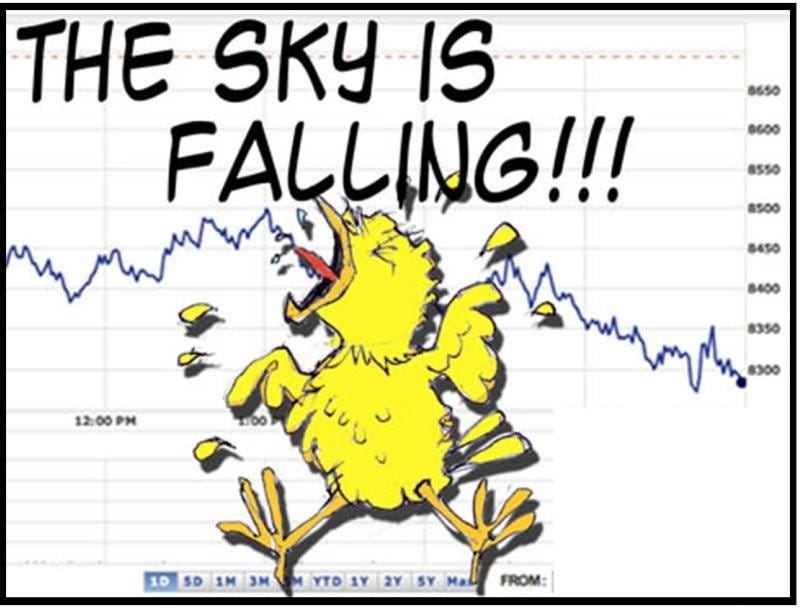
In an instant-reaction world, alarmists shorten our time horizons and push us toward decisions that ignore history, fundamentals, and human adaptability.
The Rise of Perpetual Alarm
Doesn’t it feel like the world has become saturated with alarmists? They are everywhere now — amplified by social media, cable news chyrons, push notifications, and algorithms that reward urgency over accuracy. Alarmists light the match. Others either pile on instantly or sprint in the opposite direction. Rarely do we pause long enough to ask whether the alarm is justified, premature, exaggerated, or flat-out wrong.
From a Time Horizons perspective, alarmists thrive by collapsing time. They pull future uncertainty into the present moment and demand immediate reaction. Reflection doesn’t trend. Calm doesn’t go viral.
The problem isn’t that alarms exist. It’s that they compress our decision-making window — and that compression spreads quickly into markets, boardrooms, and careers.
When Markets Trade Headlines Instead of Fundamentals
That compression shows up most clearly in business and financial markets.
Short-term price movements and narratives often overpower long-term fundamentals. The result is churn driven less by understanding and more by fear of being late, wrong, or left out.
Back in 2015, one of the loud alarms was the sudden collapse in oil prices. Crude dropped nearly 50% in six months. Energy stocks sold off aggressively. Pundits warned of cascading economic consequences. It was framed as a signal of deeper systemic weakness rather than what it also was: a dramatic but temporary shift in a complex system.
Fast forward to today and the pattern hasn’t changed — only the speed has. Whether it’s AI replacing all jobs, commercial real estate collapsing overnight, or the latest market “everything bubble,” the alarm is framed as urgent and irreversible.
But volatility is not destiny. It is information — incomplete and often emotional — waiting for interpretation.
Systems Adapt — They Always Have
Zoom out and history offers useful humility.
Thomas Malthus famously predicted that population growth would outstrip food production, leading to mass starvation by the mid-1800s. His logic was elegant. His conclusion was wrong. Human ingenuity — through agricultural innovation, productivity gains, and technology — expanded the carrying capacity of the planet.
Climate change occupies a similar place in today’s discourse. Acknowledging real environmental challenges does not require accepting every apocalyptic timeline at face value. The danger is not in recognizing long-term risks, but in allowing compressed timelines and emotionally charged messaging to crowd out thoughtful, adaptive solutions.
Longer time horizons reveal a recurring pattern. Systems adjust. Incentives change. Innovation accelerates. Pain is distributed unevenly, but solutions emerge. The world doesn’t end — it rebalances.
Widen the Clock
Which brings us back to the discipline of perspective.
The mistake is confusing a harbinger with a final outcome. Rapid change signals transition, not destiny.
Lower oil prices hurt producers in the short run. They also lower costs for consumers and businesses, redirect capital, and spur innovation. Some companies fail. Others consolidate. Still others emerge stronger, having planned for volatility rather than panicked in response to it.
Alarmists fixate on immediate disruption. Long-horizon thinkers focus on second- and third-order effects.
So the next time a “breaking” alarm floods your screen, pause. Breathe. Widen your time horizon. Run your business, career, and investments with durable principles, not emotional reflexes. Do your homework. Build resilience.
The sun will still be shining somewhere tomorrow morning.
For more essays from Time Horizons